
Doing The Right Thing

 Apple Podcasts
 Spotify
 Castro
 RSS Feed
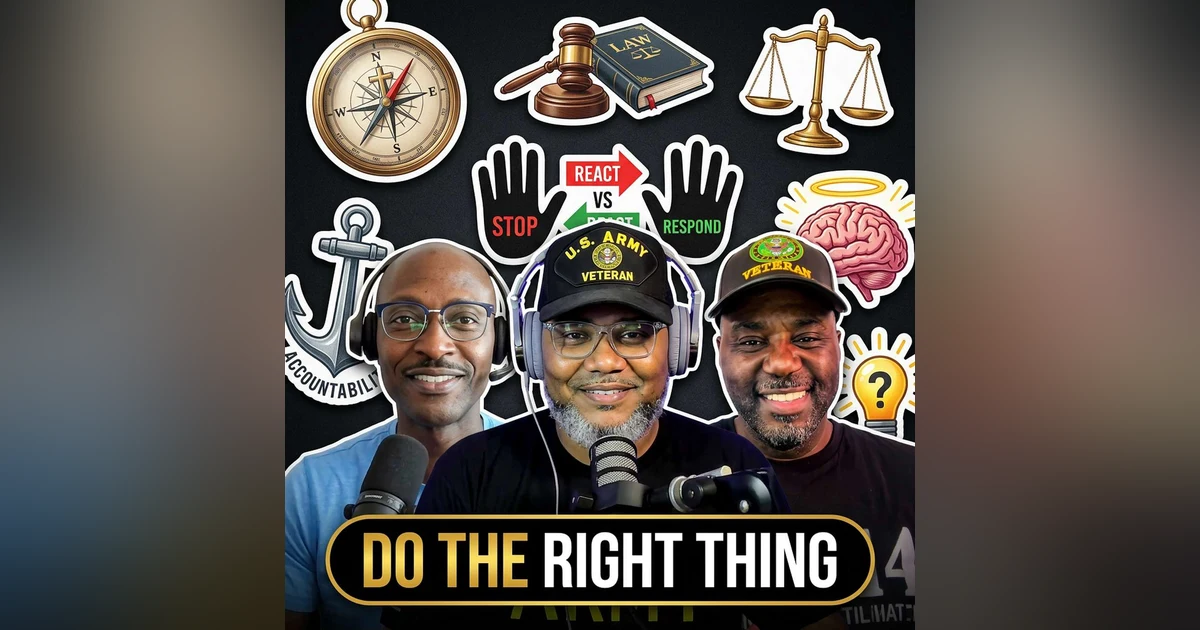
 If you could do anything and never get caught, what would you do and what would you refuse to do? That one question sounds simple until you put real life behind it: stress, money, pride, trauma, temptation, and the split-second choices we make when nobody is clapping and nobody is recording.
We sit down as Christian veterans and get honest about how integrity actually works. We talk through everyday examples like returning a wallet, then we push into the uncomfortable stuff: war-zone “pallets of money” jokes that reveal how quickly context can bend our thinking, and why “no one got hurt” is a dangerous way to measure right and wrong. We dig into moral compass, how church and community shaped many of us, and why the difference between the law and what you ought to do matters, especially when laws have not always been written in our favor.
The stories get personal. We unpack a “harmless” moment sneaking into the Louvre and what it teaches our kids, then move to a tense Las Vegas encounter where heat, disrespect, and a quick temper almost turned into a case. We also talk de-escalation, veteran mindset, PTSD triggers, and the belief that even when people are not watching, God is. The big takeaway is not perfection; it is alignment: training our hearts and habits so our private choices match our faith and our values.
If you care about integrity, Christian living, ethical decision-making, and the real experiences of veterans of color, this conversation will stay with you. Subscribe, share this with a friend who loves real talk, and leave a review with your answer: if nobody would ever know, would you still do the right thing?
00:00 - Welcome And The Integrity Question
06:00 - Who Decides What Is Right
08:00 - Moral Compass And Church Upbringing
11:10 - The Difference Between Law And Ought
18:15 - The Louvre Story And Small Compromises
22:45 - God Is Still Watching
26:50 - Maturity Changes How We React
29:07 - Vegas Heat And A Near Mistake
31:43 - De-Escalation Mindset And Self-Control
37:11 - Breaking Stereotypes In Real Time
41:23 - Funerals Repentance And The Other Side
50:02 - Veteran Context And The No-Excuses Standard
01:00:20 - Final Thoughts On Integrity And Society
Welcome And The Integrity Question
SPEAKER_02Gentlemen, gentlemen, gentlemen, so glad to see you again. Once again. So glad to see you again. Pleasure. I really appreciate you uh uh sitting with me so I could seek your your wise counsel, as always.
SPEAKER_00Urban Christian Veterans provides a safe place for Christian veterans of color to discuss the challenges you face in your daily lives. Being a person of color has its challenges. Being a Christian has its challenges. Being a veteran has its challenges. All of those factors being combined makes for a unique and sometimes difficult life experience that is seldom talked about in public forums. Thank you for tuning in to the Urban Christian Veterans Podcast. Here's your host, D'Alen Rose.
SPEAKER_02Thank you, Erin, for that wonderful introduction. This is D'Alen Rose, and you are listening to the Urban Christian Veterans Podcast. So I have this question. And this question is if no one would ever know, would you still do the right thing? If no one would ever know, would you still do the right thing? What say you?
SPEAKER_01I would say it would all on the repercussions. It depends because I do stuff like if I'm walking around and I see some trash on the ground, I pick it up, throw it in the garage.
SPEAKER_02Okay.
SPEAKER_01That's that's okay. Nobody would never know. Nobody tell me to do it, you know. And I still do that. I mostly started doing that because my kids used to be in the car, and I wanted them to see that. Um, the integrity, the whole integrity thing. So I was really big, because I had all boys and a girl, so I was really big on showing or letting my actions speak for me before. And I wanted them to see me do stuff like that. So you talk about stuff like that. But I had this thing in my head when I was younger, way, way, way, way younger. Is if I'm not, if if I'm not on this continent, then it don't count. It don't count. I ain't on this continent. Well, you can't. I'm not in this hemisphere. We ain't in the same hemisphere. Yeah, that don't count. I had this thing. But that's subjective. Yeah. That is subjective. And it depends on what context you're talking about. You know, I try to be an upstanding guy. I'd help out the, you know, help the old lady across the street, you know, that kind of thing. Well, yeah. Nobody will ever know. Now you saying, I find 20 gold bricks, you know. Do you tell somebody?
SPEAKER_06Yeah, I I think it all circles around the situation. Uh, I'll give you an example. When you're driving in your car, the speed limit says 55. Do you always go 55? No, most people they don't follow the speed limit. Most people don't. Right. If I was on one of those crews that uh got into one of Saddam's many mansions that were never used and they ran across those pallets of money, and I was with my squad, uh I I should just say that some of those stacks would have been taken and put in the in the rucksack and taken back to me to the United States. You know, but uh if I if I'm walking down the street and I see somebody's wallet and you know it has driver's license, even if it has money in it, I'm gonna return it.
SPEAKER_02Yeah. Definitely. So it depends.
SPEAKER_06It just depends on the context. Depends. It depends on the context.
SPEAKER_01Is it a life or death situation? Uh is it uh, you know, I don't know. Y'all are killing me.
SPEAKER_06Saddam, what's gonna miss that money? Y'all are killing me, man. I mean, come on, man. When they show that those stacks of palette, stacks of money on those palettes. Come on, man. I know that that that team that first got dead. Come on, I'd have been looking like each other. Take whatever you can in your rock. Nobody says a word. It happened, it happened. And the inventory started.
SPEAKER_01And people found all that gold in that cave, and it was like taking pictures with it and stuff. Come on.
SPEAKER_04If you didn't take it, okay, it was like, hey, tell me.
SPEAKER_06Mr. Rose thought this was gonna go a different way.
SPEAKER_02I I did. I really did. I really did. And you put people in those scenarios.
SPEAKER_01If you was driving down the road and the the back of the armored truck fell open, and there was a wreck. And then the bag happened.
SPEAKER_06Which acting like that? In the Midwest, it happened many years ago, and there were people stopping on the highway, jumping out, trying to grab money.
SPEAKER_02So y'all, y'all be like, won't he do it? God is good. All of that. That's that's how y'all look at it.
SPEAKER_01That was yourself, is this a test or a blessing?
SPEAKER_06Oh my god.
SPEAKER_01I'm going with the ladder.
SPEAKER_02It was a blessing.
SPEAKER_01God knew I had these bills.
SPEAKER_02Okay. Okay, hold on. Hold on,
Who Decides What Is Right
SPEAKER_02hold on. Let me, let me, let's take a step back for a second.
SPEAKER_05Yeah.
SPEAKER_02I need you to think a little higher than that for just a moment. Right, just a moment. Um why or ask this question, right? So the question is, would you still do the right thing? And I want you to take take take a step back and think a little deeper, because my question is, who says what the right thing is? Or who does the right thing? It didn't say would you follow? It didn't say would you follow the law? It didn't say any of those things. It said, would you do the right thing if nobody would ever see it. Right. Now, you guys, depending, you know, just listening to you, your mind went straight to some things.
SPEAKER_06Well, well, the right thing is determined by what your moral compass is, your upbringing, what you've been taught. That is it. I was just about to say that. Once you come of age and you know right from wrong, you're gonna have some semblance of a moral compass and what the right thing is. So that's gonna determine what you're gonna do in most cases. Uh the example I gave, I know we've been joking, but I'm walking down the street and you see a wallet. Now, granted, let's say it's cash, and now obviously somebody's gonna need that cash. The right thing, based on your moral compass, at least my moral compass, I'm gonna return that wallet. I'm gonna try the best to return that wallet. But I gave you the other example. If I rolled up on one of those mansions that Saddam Hussein had and it had all that cash, well, he ain't gonna need that. I'm gonna have to partake.
SPEAKER_01So
Moral Compass And Church Upbringing
SPEAKER_01I agree. It's subjective. It is definitely, and in our culture, um, I think we have all been taught, especially being brought up in church. And, you know, you could you got biblical context that, you know, raise a child in the way he's supposed to be raised, and he won't depart from it. So depart from it. When they get older. And if we at that foundation, and and that's like that's something that's missing now because the church is not the center of our community anymore. But back when we were kids, our churches were the center of the community, and we were all taught uh the right things to do. Now, you might not have done them all the time, but you can't say you weren't taught what the right thing, how that looked. So I think for a certain generation, we will always do the right thing when that when that when that time up happens. But like you said about Saddam Hussein, subjective. But you hear a woman screaming, oh, he's killing me, or whatever, you know, you're gonna do the right thing, or or somebody, or something as little as flat tire. You know, you're gonna go help a person with the flat tire or whatever. I don't know. But I think it's definitely cultural, especially for us, um, and how we were raised in the church. I'm gonna say in the church, how we were raised. Now, even people who weren't raised in the church, they still taught that we inherit inherent know right from wrong. We're born with that. You don't have to be taught right from wrong. You know, you know you're supposed to go slap your mama. You know, you we know that. Nobody told us that. So I believe we are born with with the sense. Now, doing it when nobody's watching or, you know, nobody's around, I th I think that's cultural. How you were raised, basically. Me.
unknownYeah.
SPEAKER_02Okay.
SPEAKER_06How you were reared and your your moral compass that you were brought up with, that foundation that was established when you were younger growing up. Now, whether you choose to do what is right and what is wrong based on that foundation and that moral compass that you were brought up with, that's a different story. Um because um I'm sure we all all have kids. Uh you you taught your kids what was right and what was wrong, and try to establish some type of foundation with them so that they don't make the same mistakes that you made growing up. But there's some situations where they ended up going down a certain pathway when they didn't have to, and they knew better, because they were taught better.
SPEAKER_02But um well, let me let me let me let me throw this in there. So
The Difference Between Law And Ought
SPEAKER_02I would say that uh in life it's it's it's more about um not necessarily um right and wrong, but ought to. Like because, you know, if you try to nothing to me is is black and white. You know, man-made laws are black and black and white, but then there's things that you oughta do, regardless of what the law says. Right? There's there's just certain things that you oughta do. Um and if it weren't for people who made the decisions to do what they oughta do versus follow the laws, then we wouldn't be where we are. Right, because the laws were not written in our favor, you know, in in our society, in in our country. It took, you know, decades upon decades of people doing the right thing in terms of what they ought to do versus what the law said for us to be in the positions that we're in today. Because if if if they just followed the law, black and white, then as I said, many of us, you know, the three of us, we probably wouldn't even be here because those who came before us may have been subject to to some law that was on the books at that time that they were in violation of simply because somebody wrote it in a way that they were they were destined to fail. But there were enough enablers around who said, No, I understand what the law says, but here's what we oughta do. And over time, some very smart, astute people followed the legalities and made it such that the laws were able to change. So again, you you've got the law and then you've got what you ought to do. And I think what you oughta do is that thing, as you said, Reggie. Um, as the Bible teaches us, is written in our in our hearts. Right. So those so so again, when you talked about the subjectivity, well, Saddam and his pallets of money or whatever, and if I ran up on it, he ain't gonna miss it, kind of thing. Um I don't judge that because you know, you could easily say, well, it's not yours, you shouldn't touch it. However, you know, there there's I'm not the one that to ever judge that because I don't have the infinite wisdom to know the downstream effects of things that are gonna happen. Right? In other words, if you leave it there, then it might be used by somebody to do some harm. Um but if you take it and it might be used by you to do some harm. You know what I mean? Like in a different way.
SPEAKER_04Yeah.
SPEAKER_02So so I don't I don't know. Um I don't know. I just know that um, you know, I try to I try to approach it like you know, do what you oughta. You know, what you ought to do might not necessarily be in alignment with man's law, is all I'm saying. And I and I can't, you know, I it also I think that if you you stay in the word as best you can, I think there's power in the word. And I think that if you read the word often, that certain things, you know, that that meter inside of you that says, here's what oughta happen, I think that will will guide you. Um but if you don't read at all and you have no concept of the word and you're just out here going simply by how you were raised, because a lot of us were raised and the know and the word was nowhere around, right? I give an example. Um I remember coming up in PG County, and back in those days, uh, you know, I lived in some apartments right outside Andrews Air Force Base, and we grew up in a neighborhood and the culture was one of survival. You know, my mom didn't make a whole lot of money, she did the best she could to to raise her boys, but we experienced a lot of lack. So the right thing was always about survival. Not breaking any laws, but we gotta make it to the next day. We gotta make sure we don't waste, we don't, you know, so all of those things are are driving me. But someone who who had plenty, the right thing to do for them is probably looking a lot different than me. But neither one of us might might be breaking the law, but each of us making decisions may impact others a certain way, if that makes sense. So that's why I say it depends. Uh to me, it's you focus on what you ought to do. And yes, your upbringing is going to probably determine the decision that you make, but I don't think it should um I don't think it should have that much of an influence on you once you become of a certain age and you start to think for yourself regardless of how you were brought up, if that makes sense.
SPEAKER_06So once you get to a certain age, yes, you know right from wrong, and you should do what you ought to do. But there may be instances where it might become subjective. Okay. It's just gonna be I think ninety-nine percent of the time I'm gonna do what I wanna do. Okay, but it might be that one tiny, it's not gonna hurt anybody, you know.
The Louvre Story And Small Compromises
SPEAKER_06I'll give you a funny story. I'll give you a funny story. Me and my son were in Paris prior to the Olympics, right? And we didn't know that you had to reserve spots. You just couldn't go up and get your tickets as maybe on a regular tour stay, or get onto the app right there at the gate and you know, get your tickets to go into the loo. Mm-hmm. So they weren't taking anyone else in.
SPEAKER_02Okay.
SPEAKER_06So um I was like, me and my son here in Paris, we're all this way, and we can't get into the loo. We're in IT. Uh we know security because when you get your CISSP or some certification, CIS CISM certification, they deal with physical security as well. It's all encompassing. Right. So I noticed something. It's a shift change with the guards. Okay. Somebody ain't paying attention. I told my son, follow me and don't stop. Okay. So we started walking, and uh some European brethren saw what was going on. They jumped in line too. And we walked straight past while this exchange was going on, and we kept on walking. So we stuck into the loop. Was that the right thing to do? No. Did it harm anyone? Is it what I ought to do? No. We did it anyway. The point is, is that most of the time, most people are gonna do what they ought to do. But there's instances where you might fall short. You know, you might have to, when they call for people to come to the altar, well, I gotta go up to the altar.
SPEAKER_02I'm keeping it real.
SPEAKER_04I get it. I get it.
SPEAKER_02I'm keeping it real. No judgment, but but let me ask you something. Why do you think they cut it off and stop letting people in?
SPEAKER_06Uh crowd.
SPEAKER_02Crowd. Probably control. Crowd control.
SPEAKER_06Crowd control. Security marshals, fire marshal, fire hazard, right?
SPEAKER_02Safety. There you go. So I'm thinking there was probably a reason why they did that. And, you know, so and again, no judgment. Folks ain't gonna make no difference. And I got you. I got you. No, no judgment. I'm just simply saying that um, you know, there might have been a reason for it, and there could have been a situation that that that arose.
SPEAKER_04Yeah.
SPEAKER_02And um they planned for a certain number of people, but then some others who said, eh, it ain't gonna hurt anything. And then some other people who seen them and went on in there with them, and and the butterfly effect being that now my man and taught his kid. I understand that there's some safety issues going on, but nah, come on, man. Let's just just do this.
SPEAKER_06Cause we threw all this way. Or if if a situation arose, because of my military background, I could have been a help to in assisting whatever that emergency is.
SPEAKER_02Right. Well, and see, that's why I'm I said uh you know earlier.
SPEAKER_06God could have placed me in that position at that moment in time.
SPEAKER_02That's why I said earlier, I'm not, I don't have the wisdom to know the downstream effects. I just simply know that when the kind when the time comes, you know, in terms of doing what you ought to do, you know, one of the things that I hadn't heard is is this, and that is the question was
God Is Still Watching
SPEAKER_02if no one would ever know. Well, there's always one person who always knows. No, not you. There's somebody else who always knows. There you go. And so I I'm a I'm human, and there will be situations that we all get into that will take your attention, regardless of what your upbringing is. You're in a situation, your mind goes to a place and you start making decisions, you start doing things. And and a lot of times if it's if it's a a fast-paced situation, you don't, you don't always think, you know, am I doing the right thing by what he would want? You're trying to make it through the situation. And I, and that in those situations, I fall short a lot of times. You know, then I think back and I like, man, I should have, you know, this is probably the way I should have handled that. Especially, man, call it PTSD or whatever, but I just got this short view sometimes when somebody will like I have very low tolerance for foolishness.
SPEAKER_06Yeah.
SPEAKER_02And then when it comes at me fast, you react. I right. It's a it's a reaction. And then later I'd be like, man, I really, I really shouldn't have done that. Right. But when the situation is calm and I got time to think it through, I don't know that I be calculating the security measures of the places. That's just me.
SPEAKER_06That's just me. Look, you know. This pastor gave this sermon many years ago. And he said, if you're ever thinking about doing something wrong in your car or wherever, look to your right or left and imagine that Yahshua, Jesus, is right next to you. And all week long, you know, if I'm driving, if you're having certain thoughts or whatever, I remember looking over. Jesus? You there? I did the whole week. And it's it's it sat in my mind. And he said, anytime you you feel you're gonna do something that you're um not supposed to be doing, but you should be doing something that you ought to do, he said, Imagine Christ is right next to you. And I was like, man, that that was pretty good. He said, Imagine that he's with you right there. Now he's with you, but he he was literally meaning he's physically, you can physically see him right there. And will you do those things?
SPEAKER_02Yeah. Look, he he just wasn't there during the shift change. And so he was there.
SPEAKER_06It's just like I was like, I don't see. He was there. He was there because I was thinking, I was like, should I be doing this? But that was in the moment, man. Hey, I felt short. That's that flesh that you battle against.
SPEAKER_01Absolutely.
SPEAKER_06Absolutely.
SPEAKER_01Maturity plays a lot in and becoming more self-aware, get into your word, you know, that does play a lot. Even if you had no, as a youth, you was rambunctious and you was outside and you in and out of the system, and once you got introduced to the word, that is supposed to change you too. And I think that happens with people. Because like you said, some people didn't have it, that uh that oh church upbringing like we did. Um, they got it later. So uh better late than never, I guess.
Maturity Changes How We React
SPEAKER_02Well, I think that that is one of uh the most overlooked aspects of God's design, meaning getting old and and maturity. Because as I've gotten older, you know, there are certain things physically that I know I just can't do like I used to. Especially when it comes to confrontation. Right. And so now I'm forced to think first, where many years ago, it's whatever, right? It's it's it's gonna be and then you know, you would think you're bulletproof. You think you're, you know, whatever situation, especially if it came to having to throw hands, yeah, I'm you know, I could probably handle myself. I might not win, but it's gonna be a problem out here, you know, that kind of thing. I don't even think like that now because I'm like, I already know physically there's certain things I can't do, but this works. And I'm like the the how can I say the wisdom in me says that might work however there's consequences with that. And it makes you think. So the so God's design in making you get to the point where physically you can't do certain things like you used to causes you to have to rely on wisdom. And I think that that, you know, that gets overlooked. Like a lot of us we curse getting older. Man, getting old it's not for punks, because this thing is, you know, is rough. But the design is such that, yo, this I'm better. Even though physically I'm not where I was, overall, I'm better than I used to be. So it's kind of how I see it, you know, in terms of the decision making, you know.
Vegas Heat And A Near Mistake
SPEAKER_02But you know, check this out, man. We we were in, told y'all I was in Vegas, right, with my wife last week. And uh I it's it's hot outside. I'm trying to get my wife in a cab to go right across the street because it's hot. I don't want her walking out there. She could have walked in the building, but it was a longer walk. You just, you know, Mr. Cabman, just take her right over here. The cab drivers start tripping. I've been waiting 45 minutes, and all that's gonna be is a five-minute thing, and it's not, it's not worth my time. You can just walk. And plus, he had an accent. Like, I think he was Middle Eastern. So that even more just got under my skin. And so now I'm ready. I'm going toe to toe with this dude. It's hot. I'm going toe to toe with him. And my wife is like, let it go. Don't engage. Like, I can just walk right over here. There's a train. You know, they had a little, whatever you call it, the tram that goes back and forth.
SPEAKER_04Yeah.
SPEAKER_02And but because I, because I reacted, you know, I'm thinking to myself, what are you worried about? You were sitting out here for 45 minutes with two flat tires. How long do you think you're going to be sitting? You know, I'm, I'm, I'm running through that in my head. Yeah. And it took for her to say, it's just really not worth it. Let me just walk over here and get on this tram. And then when she said that, it bothered me more because I'm like, the tram got to go up that way and then come back to go to where you're trying to go, which is still better than walking, you know. But at the time, the way he responded, you know, not very customer-friendly at all. And just, I'm like, man, I'm a guest in your town. I'm I'm all kind of stuff running through my head. Plus, he only weighed 78 pounds. I was like, oh, this one, I I can get this one. You know what I mean? But after she got on there and she said what she said, I thought about it later and I was like, you know, the way I could have really got him to do it was say, pull out a 20 and say, hey man, let's take her over there. And he would have done it. And, you know, you're tipping people the whole time you're there anyway. But because he came at me, I responded or I reacted. It wasn't even a response, it was a reaction.
SPEAKER_06Mm-hmm. Yeah, it was it was his immediate escalation, and you met that escalation evenly.
De-Escalation Mindset And Self-Control
SPEAKER_06Uh uh a couple years ago, I talked to this police officer guy I knew, P. G County. He was SWAT. And um he, when I think a lot of stuff was going on in the community, I forget the year and who was killed, it was just a lot of uproar. So I wanted to get his perspective on what was going on. And one thing he said, you know, Greg, when I approach a scene, I try to come in at a certain level, unless it's something that's active, shooting going on, okay. He said, I try to come in at a certain level. I don't come in up here, okay? And I'm gonna approach whoever I'm dealing with at that minimal level. Now, if that person doesn't meet me at that minimal level and he's here, depending on what he does, is gonna decide how much I escalate, okay? He might go a little above me, and I still may choose to stay down here, okay? Or I might just escalate a little bit past him to try to get the situation under control. Now, if he takes it up here to this level, then I have no choice but to take it to that level as well. So he said it's just on how you approach things. Just like you in the state of Georgia, um, in Texas, I carry, I've I've carried for many years. And one thing I try to take into consideration, especially when my boys there were taking martial arts, when they were again to a point where some of the moves could have deadly consequences. So there's certain things that have to be uh have to be settled before deadly force. And sometimes that's that settling of those items happens real quick. That's ability, opportunity. Ability is do they have a weapon that can harm you? Opportunity, are they in proximity where they can harm you? Uh preclusion, that's the de-escalation. And then jeopardy. I fear for my life. Okay. So, yeah, that mindset, because I have to always have that mindset when I when I leave the house, because in the moment's notice, because I have a quick fuse. I know what can happen. And it happened a couple years ago at Costco when another person from that region uh he got loud with my wife, and I addressed him, and before I knew it, my my finger was on his nose. And I was face to face with him very close. And he kept on going. The next motion, I had already pulled out my blade that quick. So going back to what Rose says, you gotta sometimes watch your mindset and really think. Be swift to hear, slow to speak, slow to wrath. Yeah. Okay. Okay. So it's all about thinking about, you said you don't you don't have the wisdom none of us do of what's to come if you do a certain thing. Because every time you do certain things in life, it creates reactions. Reaction. If you if you look a if you look over your life and you say, man, if I would have done this, then this possibly could have happened. This pathway would have opened up. And you didn't see it back then, but man, now you see it. It's just like you ever seen one of those social media posts. Um you you think if you go down this path, this is that God is leading you. You don't see exactly what it is, but then behind that door, behind that obstacle, you see the the real blessing come forth, you know. But you see this, what looks like a big blessing going down this pathway, it's really not the way you want to go. So um it's just having that mindset, and you touched on it, having the wisdom to sometimes do what is correct and what it is what you ought to do. And I think most people will do what we ought to. I know we were joking earlier. Well, I still would have took some. I know you will, I know you will. Keeping it real. But for the most part, yeah, yeah, we we we're all gonna do what we ought to do. Most people, especially when you get to this age, we're gonna do what we ought to do most of the time. But sometimes you still battle with that flesh. And um that that's that's a constant thing. You have to battle with that that flesh. Look, look, uh, just like Lot's wife, you know, she got out of Sodom and was on her way, and she only had not to do one thing. And what? Yep. She looked back. Joker looked back. Look back and uh pillar song.
Breaking Stereotypes In Real Time
SPEAKER_01I absolutely I started to make a conscious effort to break stereotypes when people looked at me or reacted to what I do did, and that became a habit. So I'm like, somebody's always watching you, whether you know it or not, somebody's always watching you. And am I gonna be the stereotype to where they so whether other people be like, yep, see, that I knew it. Or we're gonna break the stereotype and give them another perspective. And the how I started doing that was at Fort Bendon, and when I was in um high school, I was in carpentry, and I made a little bolo back, you know, little knocker. I had made it, shaved it down. It was only about 18 inches long. And I would keep it in my car, and I had to hoop dee. That's what we call my car, I had to hoop dee. And that car full of full of the fellas, we coming back on post, and that side gate before you go out, you know, the Victory Drive gate, they had that little side one where the McDonald's was. They had a Yeah, yeah.
SPEAKER_03See.
SPEAKER_01And I see this person, this man, up on the bridge, and I didn't I'm because I'm driving, they're talking, they're not paying attention. But the person's when when when my car comes under there, he spits down, like almost like trying to spit on my car. And I was enraged. I got hitters, because at that time we all was carrying guns. I turned and nobody knew because they weren't paying attention. I turned and I grabbed the stick, jump out the car. I'm like, oh no, you're not trying to spit on. It's first of all, it's a hooptie. Nobody wants to be, it wasn't a BMW, it was the hoop.
SPEAKER_02Right.
SPEAKER_01You know, needed a paint job and three hug caps, you know. And I was like, why would you spit on the hoofty? Not them other cars. I jump out, grab the stick, and I run to the bottom of the stairs. So now all the fellas are like, yo, it's going in because he done grabbed a stick. So now they jump, they're getting ready to jump out. And when I get to the base of the stairs, I look up, it's a kid. And he's like, Oh, oh, I'm sorry, I'm sorry. Uh, you can hit me if you want to. And that that was that moment for me, was like, this is this guy's mentality that, you know, black guys are violent. And I'm thinking in my head, what he spit, that's disrespectful. Oh, if it's, and it was a man, you know, but when I, because he was so far away, I thought it was a man, but when I got to the base of the stairs and get ready to go up, it was a kid. And then that was the catalyst for me to say, I'm gonna start breaking these stereotypes. Because that was his stereotype, and I was like, dude. By the time I looked up and said, dude, all the fellas had came out of the car. It was like, yo, what? And I was like, Do you see all of these? Something could bad could happen to you. Stop doing that. So I taught a lesson instead of giving them a beating, you know, and but that was the catalyst for me to start breaking stereotypes. And doing what you ought to do, that became, I would try to make that a habit and teach that to all these numberhead boys and kids who are in my stead. So that that was is for me. Busting these stereotypes made it a habit and of doing what you ought to do. And that that comes with wisdom. That was a moment, because that was a moment for me. It was gonna be all, you know.
SPEAKER_02I wonder if I know some of these hitters.
SPEAKER_01Uh yeah, you know, all of them. You know every one of them.
SPEAKER_02No, no, but um every one of them, you know. So I I'm I can imagine, yeah.
Funerals Repentance And The Other Side
SPEAKER_02Um, you know, the the the thing for me is uh over the last few years participating in so many funerals at church. And the message always is we're you know, funerals are for the living. So we are we we tell the living that this is not the end. There's a continuation, we're all gonna be on the other side one day, and we should rejoice in that. But if you believe that, then how you behave right now is going to have impact on what that looks like on the other side. And once I, you know, years ago got that ingrained in me, that's what makes it easier for me to do what I ought to do. Because I'll just put it this way I got a lot of making up to do. That that just wasn't cool. And and it's beyond the first half, right? But then when I became a new creature and my eyes were opened, one I knew I had to to make changes moving forward, two, it was easy, it wasn't it wasn't difficult because when I became new, it just who is it's who I am now. Right. Um but I still have memories and I still remember, yeah, that was foul, and I had to repent. And every time one of these memories comes up, I repent again. And I'm like, man, that sure is a whole lot of memories. Things just keep popping into my head about stuff that happened, and I'm always like, I can't believe I did that. And I have to repent, you know, ask God for forgiveness, because even now I say to myself, I don't even know what I was. Thinking, like I don't even understand. It's not even in my nature to even want to do anything like that now. And I speak a lot of times when I talk about the past about how I used to be, because it was in my nature back then. It really was. It was like part of who I was. But now I think about some of those things and I'm disgusted by it. And so moving forward in terms of doing what I ought to do, you know, years ago, uh, Greg, to be honest with you, I probably would have, you know, with the pallets, I probably would have snatched a little something, you know, with Saddam's, you know, whatever, in his mansions and all that. And probably wouldn't even have blinked, just did it. But now, the thought of that don't even sit well with me.
unknownRight?
SPEAKER_02And it's not supposed to.
SPEAKER_01It's not supposed to. Well, well, but here's the thing. The reason why it doesn't we're supposed to get away, throw away all that stuff.
SPEAKER_02No, but the reason why it doesn't sit well with me is because I'm a firm believer that I'm gonna have so much better on the other side. Right? I firmly believe that. And, you know, it's not just about material things either, because when we we talk about the funeral situation and you're trying to comfort a family, it's when you believe that in your core, it's easy to talk to someone and say, man, don't it, it's gonna be better. And we have to believe it. We're gonna be better on the other side. That person is gone. And if anybody needs to be sad, it's you about you. You don't need to be sad about them because they're good. It's you that still got some years to deal with this foolishness down here. We need to be sad about that. But they're good. We're trying to get there. Right. So I really believe that in my core. And so the question about would I do certain things if no one would ever find out if they weren't watching or whatever. I always think, sorry, not always, when I am conscious and able to, I think about the other side. But sometimes when those situations pop up, and my trigger response is just to just come with whatever's on my mind at that time. Just pure reaction. Yeah. I I fall short. I I admit that. That that cab driver almost caught one. Because it was hot outside, too, man. It was hot. Yeah. Yeah. Outside circumstances.
SPEAKER_06You know, yeah. It does that.
SPEAKER_02So yeah. I mean, to her unit. Well, but bro, you can't be 78 pounds and it's 111 outside. And you're telling me that my wife just should walk. That's the wrong thing to do right now.
SPEAKER_06There you go. He he was he said something about the wife. Yeah. And that's where I lost it. Yeah.
SPEAKER_02But but it was it was my wife who said, chill, don't engage. It's it's okay. See, that's your balance, your help meet.
SPEAKER_06She was trying to That's right. Right.
SPEAKER_02She knows from you. I give her so much credit for how I'm living today. You just wouldn't believe. Like she she is my my anchor. Right. But at that moment, I was like, oh. It's the E. Okay.
SPEAKER_06He knows. It's that PG County. And you it's still you could take him out of PG County, but you're not gonna take PG out. It's there's gonna be a little smitten of it always left in him. Yeah, it is what it is.
SPEAKER_02No, but what's funny, man? You say that. That needs to be studied, though. Like everybody that I know from PG, like everybody that I've run across in my adult years that I didn't know growing up, but just know that they're from there. And we talk, everybody was programmed with I don't know what it's called.
SPEAKER_06But it's just we were just all programmed with that. Yeah, they just beat counted. No, but we only could talk because that's but that's what we know. Right. And I I know you're right, Reggie. You there's people from California, from New Orleans, everybody could say it is just, but there's just something that's in there that if you're from that certain area, just like I I could relate to certain things with D-Row. If you were in California and two guys from a certain area in California, they could relate to certain things, it is what it is. Um I can understand the lingo, how how you talk, uh, how you say certain things. If I say Ben's Chili Bowl, everybody going on IU Street, you know, everybody like that. I can smell it when you yeah, yeah, yeah. It's just certain things that you know. If I say uh, you know, um Celebrity Hall or the Black Hole or something like that, you even if you never partake, you you know, or say EU or Essence, or if you're from the area, you have uh something in common where you where you know. So when you when you say that and uh you went there uh and then the heat on top of that, we we get it. You make angry.
SPEAKER_04Yeah.
SPEAKER_02Well, I I I compare it to with with with what you just said, I compare it to veterans versus non-veterans.
Veteran Context And The No-Excuses Standard
SPEAKER_02Right? That's like when when you're out in in wherever, public, when you're you could be at church, what have you, um there's just certain things that you don't have to explain to a veteran. You can say a few words and don't have to explain, and and they get it. And I'm at the point now, I've I've come to realize that I don't hold it against people for not understanding why certain things are important to us as veterans, because they don't have the same experiences, right? That's kind of why I started this podcast, because I wanted them to I wanted a platform for us to just talk so they can understand how we think and hopefully if they care to uh understand us and be able to relate to us better. You know, that's because we probably said some things today that um just sound a little wild to to certain people, but being a veteran, you don't have to explain it um to to one another. When you said Saddam and you said the the pallets and the money, yeah. That sounds like wild, like a movie I might have saw or something, but there's a lot that goes with that. There's a lot that goes with how we got to where we were, how we got in there to see the pallets, the the dangers that were faced. And you ain't gotta explain all that. We know everything you went through to get to in that room to see all that. And I can understand why you were like, man, yeah, I gotta get this, you know. I'm gonna do all that to get right. Take what you care, keep your mouth shut. That's it. I and you didn't have to explain that to me. I get it. You know what I mean? But to somebody else, it might sound like that joke a greedy, and he, you know, he just, you know, just thieving, you know, all of that. Yeah. But you ain't gotta explain that to me. I get everything that you go through to had to get there. And then what you're gonna face when the higher-ups get there and want to take credit for everything you did, right? So you gotta get your, you gotta, you know, I get it. You didn't have to explain that to me. But others probably didn't understand all of that stuff. And that's why I tease, but I get why you was, you know, okay, security. It's a shift change. We can, you know, we came all this way. We're gonna do what we gotta do. I get it. You don't gotta explain to me. I get it, you know. And so But is it what you ought to do? No, you know, and and that that's the thing. It it's maybe it's not what you ought to do. Um you know, a lot of times many of us come up with the belief that there are degrees of sin. No, sin is it. Like some exactly. Sin is sin. Yeah, but a little thick. But here's the thing some people might sin and say, Well, nobody got hurt. Right? Other sins might be very detrimental, and and a lot of people get hurt. But that's what I'm saying. If you if you have that mentality where there's degrees, then you're more likely to not do the right thing. If no one's gonna get hurt, right? So that's why I said I wanted you to take a step back and think at a higher level, because those types of things have to be taken into consideration if you are a true believer and you know what's in store for you on the other side.
SPEAKER_04Yeah.
SPEAKER_02Right? So that's all, man. Just, you know, day-to-day. Try to remember that. And uh do the best you can, man. That's all. That's all I can say. Do the best you can. Yeah. Pray every day. So uh uh. So, so right now, like I told you, I was in Vegas. It was 111. 111, just an easy 111. So it wasn't like it was it was trying to get there. It was just 111 just off the rip, right? Every day that we were there. Like, like um, now here's the thing. You know how you you you you you pull out the weather app and you say, what's the weather gonna be in the next for the next few days? And on the weather app, it's it's going up and down and it might, but when that local news comes on, and that cat says, Oh, well, the high is 111, you know, and the low is gonna be 89 tonight, you know, like every day though. So I'm trying to understand. Living in a place like that, first of all, shout out to people who live in places like that and and thrive. Because I I don't see how that's possible. Right. But when they call Vegas Sin City, I think it's because it's too hot. Like, you know what I mean? Like, you get hot out there, you just do some stupid stuff, man. And like I told you, the cab driver said a little something slick to me. And then he involved my wife. And so now I'm like, I know it wasn't the right thing to do now.
SPEAKER_01They need to do that in the cooler months. That's what they need to do.
SPEAKER_06Well, they say uh when it gets warmer, crime goes up. Yeah, that's a statistic.
SPEAKER_02That's the actual statistic. Okay. Well, I was almost a statistic. Yeah, I was almost a statistic. And uh real statistic. Your boy almost caught a case because I was I was like, and and you know, unfortunately, and I only share this because um I really for a split second lost it. Like, like if my wife wasn't there to say what she said, I'm thinking back to the experience. You don't know what happened. Right. I I I'm thinking back to the experience.
SPEAKER_06Pastor Dr.
SPEAKER_02Dennis Rose has snatched up a camp driver in Las Vegas. Nah, man. No, but you know, there were too many, there were too many, I guess, aspects and circumstances tied into that situation. Meaning it's hot, you only weigh 78 pounds, you got this accent, and it's hard for me to understand you. And then you're doing this like she can just walk. That's a problem for me. Oh, he shoot it. Yeah, he yeah, she can just walk.
SPEAKER_06Yeah. So D Row was here. I might have, I might, I might have I might have caught him one. I might have caught him one. I I'm asked to ask to forget.
SPEAKER_02I might have, I might have just Talita walk around and over snatched that door open. What? No, but but but but what I'm saying is, thinking back, there were no breaks. You know what I mean? Like there was no breaks. It was, it was, it was all go, no breaks. And and it was her voice that was like, snap out of that. Come on, you know, whatever. And even then, I was still like a child pouting, lucky, you know, like because I still I still felt a little something in me, but but you know, again, I'm sharing it because that's one of the few times where I actually I said one of, because there's been others, but that's one of the few where for a moment in time I had no breaks, I had no cares, that the only thing that mattered was he was wrong in my mind, and um, and and the situation was right, you know, again, you 78 pounds. I'm you know what I'm saying, I'm about to fold you up, you know, out here. And then quickly though, soon after that, stuff popped in my head like this is Vegas, cameras everywhere. You know, like like I'm just gonna be dead. Wisdom.
SPEAKER_01Wiz that's what that's called. That's called wisdom.
SPEAKER_02But you know, so in terms of doing what you ought to do, that's an experience where it wasn't knowing what I ought to do until later.
SPEAKER_04Yeah.
SPEAKER_02Right. At the moment, I didn't know what I ought to do. You know, I ought to snatch this cat up. You know, that's what I was thinking. I ought to, you know, but it wasn't right. So um You're done good, brother.
SPEAKER_01You're done good. Very good. God gave you her for a reason. Yeah. Shout out to your wife. Had it been somebody else, you might not have heeded the the the heated what she said. Like, so shout out to your wife.
SPEAKER_06Oh yeah, Greg Harry was standing next to you. D Rose. Tighten that dude up.
SPEAKER_02Like, I'd have been like, you know, block the cameras. You know what I'm saying? Like, right. But no, real talk, man. But um, on that note, do you guys have any final thoughts on the topic?
Final Thoughts On Integrity And Society
SPEAKER_02Um, if no one would ever know, would you still do the right thing? Any final thoughts on that?
SPEAKER_01I think we being believers, first and foremost, we it's in the front, not even in the back of our minds, but in the front of our minds, as he's always watching. So we we we are supposed to govern ourselves as if the Most High is watching us. And that will determine, that will ensure that we're always doing the right thing even when nobody's watching. Supposed to be.
SPEAKER_02Okay.
SPEAKER_06Yeah. Um I I I that's that's good, Rich. Uh yeah. You asked the question earlier, Dear Rose, there's someone who's always watching, and that's God. He's always watching everything that we do, and he knows. So you're gonna have to uh look at yourself and determine um are you willing to disappoint him? Um are you willing to disappoint yourself? Are you willing to disappoint uh family? Um so you you just have to make the determination on how heavy is that possible repercussion, you know. So that's a determination you'll have to make for yourself. But I I'll go back to what I said. I think for the most part most people will do what you ought to do regardless of who's watching, but and you still battle with that flesh sometimes, so we all will strive to do what's right.
SPEAKER_02Well, so you said something earlier about the moral compass and I think it was profound because it's one thing when an individual uh either ignores it, doesn't have it, or loses it. But when an entire society loses its moral compass eventually the society loses its sense of direction. And if you just look around us right now, the direction that we're going in as a society, not as individuals, but as a society and how we're seeing across the world, it is evident that we're not being led by a moral compass, a working one anyway. And so God's perfect design, where we as individuals have these moral compasses that you mentioned. Um and Reggie said, where these things are written on your heart. I think you have to uh keep that in mind, as as Reg said, at the forefront. Not like me, when it's hot and the cab driver weighed 78 pounds. That wasn't at the forefront. It wasn't at the forefront of my mind. But you know, I gotta learn from that and I gotta do better. And uh, you know, so um just a moment of transparency. I lost it for a minute, but I'll do better. I'll do better. All right, gentlemen, thank you so much. I really appreciate you, and as always, um, you know, we'll do this again soon. And may God keep you. Uh may God be with you. Um, and listen, um, I really appreciate this one because it felt like a therapy session. Like I had to get this one off. You know what I mean? Like, yeah, yeah. I needed somebody to I needed somebody to tell that one too, because it blacked out, man. I was I was I was lost on that one. But again, thank you so much, gentlemen, and we'll we'll do this again soon. All right, most definitely. Thank you. Most definitely.

